Session handoff
Handoff moves ownership of a running session from the device that started it to another enrolled device. It is a durable backend state machine, not a tunnel: no process, socket, or memory image crosses the wire. The target rebuilds the session from a sealed checkpoint.
The state machine
requested
  -> target-prepared
  -> source-quiescing
  -> source-relinquished-and-checkpointed
  -> ownership-transferred
  -> target-activating
  -> completed        (or cancelled)
The record is durable on the backend, so a device going dark mid-handoff leaves the state machine where it was rather than corrupting it.
Readiness gates first
Readiness is evaluated before anything moves. A dirty working tree or unpushed commits on the source blocks the handoff and reports concrete remediation, commit or push, then retry, instead of failing halfway through a transfer. The check exists because the checkpoint pins exact commits: a target cannot materialize work the source never committed.
The sealed checkpoint
When the source relinquishes, it captures a checkpoint: the session's continuation state at an exact commit.
- The checkpoint body is sealed under the ADK like any synced payload, AES-256-GCM, with AAD bound to the handoff id, so a checkpoint swapped into a different handoff fails unseal.
- The two CAS fields stay clear: the content-addressed references the target needs to fetch the checkpoint body at all. Everything about the session itself is inside the seal.
- The target unseals the checkpoint before rendering the continuation prompt. A missing key version or a tampered body aborts activation before any provider call is made. A failed handoff never spends tokens.
Ownership generations
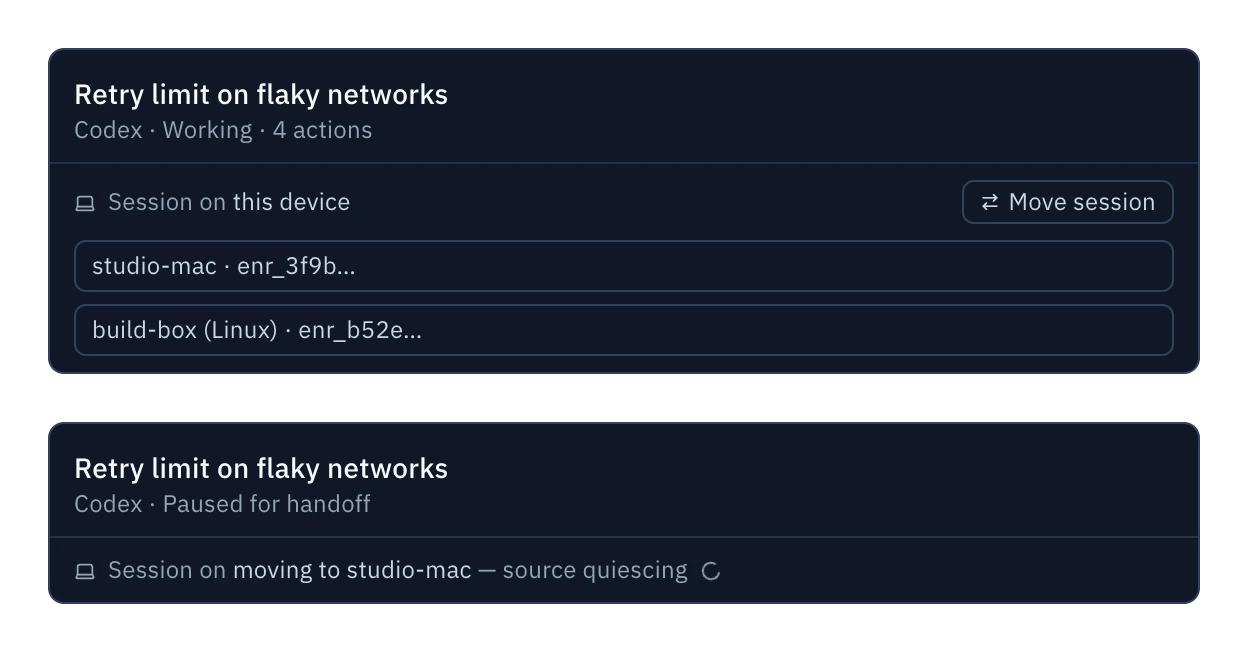
Ownership transfers at a fenced generation: each handoff increments the session's ownership generation, and stale devices acting on an old generation are rejected. That is the split-brain defense. After transfer, the source cannot keep driving the session even if it still believes it owns it. The ownership strip in the run view shows which device holds the session.
What "no live process migrates" means
The provider process on the source does not move. What moves is the ability to continue:
- the source quiesces, durably rejects new input, and checkpoints;
- ownership transfers to the target at the new generation;
- the target prepares the workspace at the pinned commits and resumes the provider session.
How the resume looks depends on the provider: some providers support checkpoint import (the session continues with its real state), others get a summary continuation (a rebuilt prompt carrying what the checkpoint says happened). The handoff record states which path was taken. Either way, the user-visible contract is the same: the conversation continues on the target, at the same commits, under new ownership.
Using it
In the run view, the ownership strip under the agent map shows the current owner. Move lists eligible devices (enrolled, reachable, capable of the workspace) and starts the state machine. The full readiness evaluation runs first; if it blocks, you get the reason and the fix, not a partial transfer.
Current limits
- Backend state machine and sealed-checkpoint behavior are covered by tests; a physical device-to-device handoff demo is still pending.
- Resume fidelity is provider-dependent. A provider without checkpoint import gets summary continuation. It works, but it is a reconstructed prompt, not the original session state.
- A blocked handoff requires source-side cleanup (commit, push) before it can proceed. There is no "handoff anyway". The checkpoint pins commits, so uncommitted work cannot cross.